
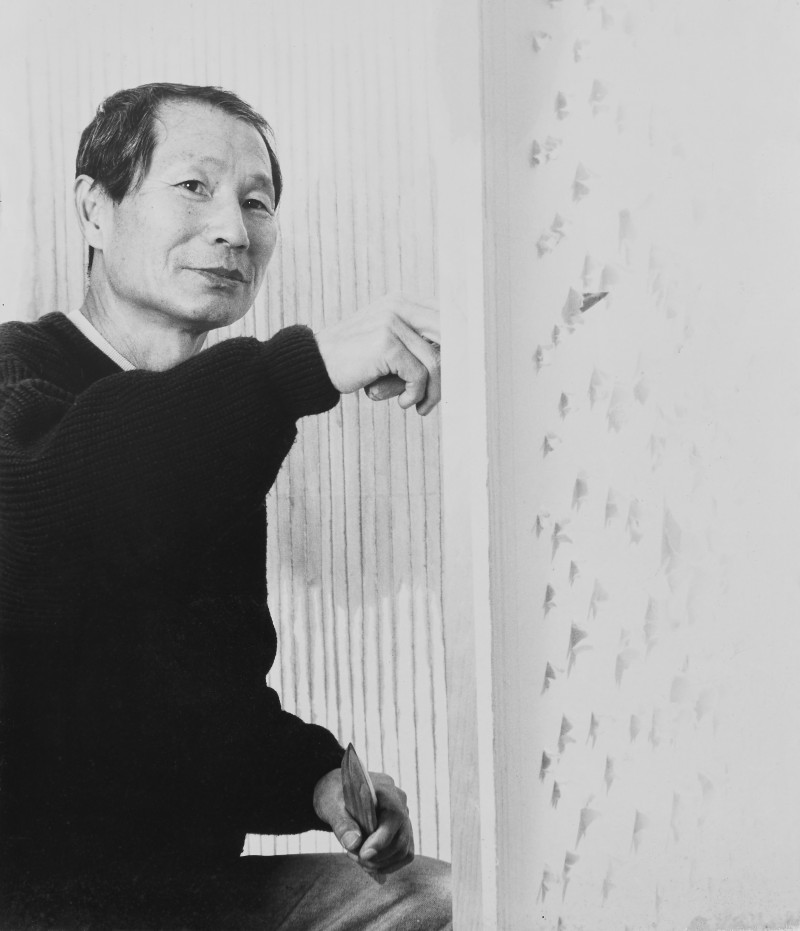
Kwon Young-Woo
Early in his career, Kwon Young-Woo (1926-2013, Korean) explored figurative abstraction using Chinese ink, a common Korean painting material, before deciding to use hanji (traditional Korean paper) in 1962 as the primary medium for his artistic production. By renouncing the brush and the traditional emphasis on painting a picture, and opting to use his fingers to cut, tear, puncture and glue the paper together, Kwon put repetitive action and the paper’s delicate materiality and tactility at the forefront of his practice. This unique approach was widely recognized for expanding the definition of traditional Korean painting. Kwon resided in Paris in the 1980s, where he experimented with his works Western (gouache) and Eastern (ink) mediums. Allowing the color to permeate into the paper’s torn edges and embracing the unpredictable encounter between the paper and the paint, Kwon suggested a modern alternative to the inherent dichotomy of the Western approach; separating the paint from the canvas, and the subject from the object.
권영우(1926-2013)는 한국화의 기본 재료인 수묵으로 구상적 추상의 표현 가능성을 탐구하는 작업을 하다가 1962년을 전후하여 필묵을 버리고 한지(韓紙)를 작품제작의 매체로 사용하기 시작했다. 그는 종이 위에 그림을 그리는 화가의 기본 행위를 배제하고, 대신에 주로 손톱을 이용하여 종이를 자르고, 찢고, 뚫고, 붙이는 행위 등을 통해 작가의 반복적인 행위와 종이의 물질성과 촉각성을 작업의 중심에 놓는다. 여러 겹으로 겹쳐진 종이의 섬세한 재질감을 강조하면서 작가는 종이 위에 만들어진 입체감과 리듬으로 조형성을 구성하였는데, 이는 동양화의 매체를 재조명하여 동양화의 영역을 초월한 새로운 문법을 만든 것이라 평가된다.

Kwon Young-Woo (b.1926-2013)
Untitled
c.1980s
Color on Korean paper
Image size: 68 x 74 cm
Framed size: 78 x 83 cm
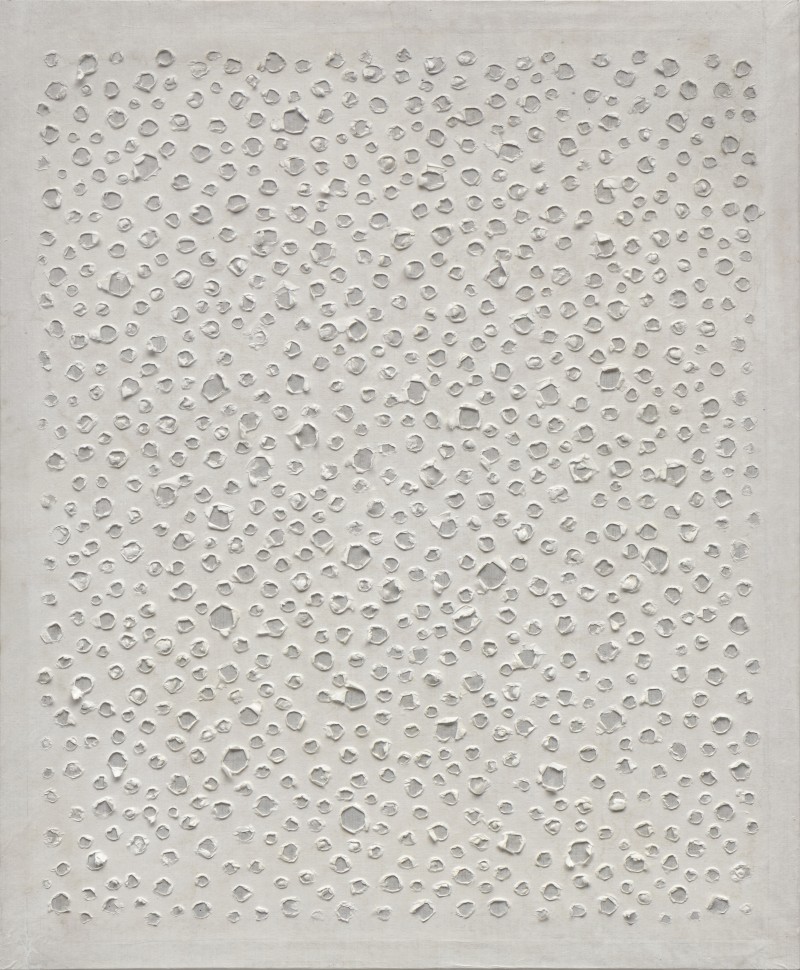
Kwon Young-Woo (b.1926-2013)
Untitled
c.1980s
Korean paper
70 x 57.5 cm